

The Huddersfield Narrow Canal
Short but steep, the Huddersfield Narrow Canal rises into glorious Pennine moorland with many reservoirs and swathes of National Trust land. Dubbed ‘the impossible restoration’ the HNC was fully restored to navigation in 2001, with the help of £5 million Millennium Project funding.



Feature Spot – Around Standedge Tunnel
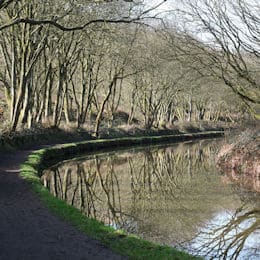
From the Ashton Canal junction at Whitelands Basin the HNC soon begins the 32 locks on the 9 mile slog up to the Standedge summit. Once the mills and urban sprawl of Ashton and Stalybridge are left behind the Pennine Hills come into view ahead as the canal climbs the pleasantly wooded Tame Valley.
After rocky Scout Tunnel the attractive tourist villages of Uppermill and Dobcross are worth a stop to get your breath back. Dobcross has 58 listed buildings. Enjoy them before the last locks are tackled and Standedge Tunnel reached.
The canal can be a challenging one to cruise. Locks on both sides of the summit can be hard work and pounds often shallow or leaky. The restoration left ongoing problems with lock equipment, the state of the channel, and the sheer number of locks. All combined this can make cruising the canal hard work, especially in deeper boats. Having a good fit crew is recommended!


ON THIS CANAL…
Standedge Visitor Centre tells the story of the tunnel, from its planning through 200+ year’s of history and its rescue, restoration and reopening in 2001. Trip boats with wheelchair access normally run through the year from the tunnel entrance by the Visitor Centre.

 Shire Cruisers
Our base is ideally situated for discovering the HNC on a one way trip or Pennine Ring. Shire Cruisers, the specialists in northern waterways, with carefully looked-after boats and very thorough lock instruction.
Shire Cruisers
Our base is ideally situated for discovering the HNC on a one way trip or Pennine Ring. Shire Cruisers, the specialists in northern waterways, with carefully looked-after boats and very thorough lock instruction.
Standedge Tunnel is 17,000 feet long, one-third bare rock, 638 feet below ground and 645 feet above sea level. Boaters are now able to take their own boats through with a CRT ‘chaperone’. However, cruising the canal still needs careful planning since CRT staff must assist boats through some of the locks and boats must be booked for tunnel passages. Standedge Tunnel preceded three railway tunnels and took 16 years to construct nearly bankrupting the company. Locks up either side were open after three years (1797) but packhorses took transhipped goods on the turnpike for fourteen years until the tunnel opened.
The downhill trip from Marsden involves 42 locks dropping along 20 miles of wooded Pennine hillsides before reaching the industrial outskirts of Huddersfield. Apsley Basin is the start of the short Huddersfield Broad Canal which extends for just over 3 miles to the Calder and Hebble Navigation. The Aire and Calder Navigation can then take you to Leeds, and the Pennine Ring via the Leeds & Liverpool Canal if you’re brave enough and have a few weeks spare!


All materials and images © Canal Junction Ltd. Dalton House, 35 Chester St, Wrexham LL13 8AH. No unauthorised reproduction.
About | Terms | Privacy| Refunds & Returns| Sitemap | Contact Us
With over 800 pages, this website uses cookies to record visitor behaviour using Google Analytics. More information on Privacy Page. Page last updated: 15/01/2025.
Back to Menu....
Canal Maps & Guides >>